The Best Technology Disappears
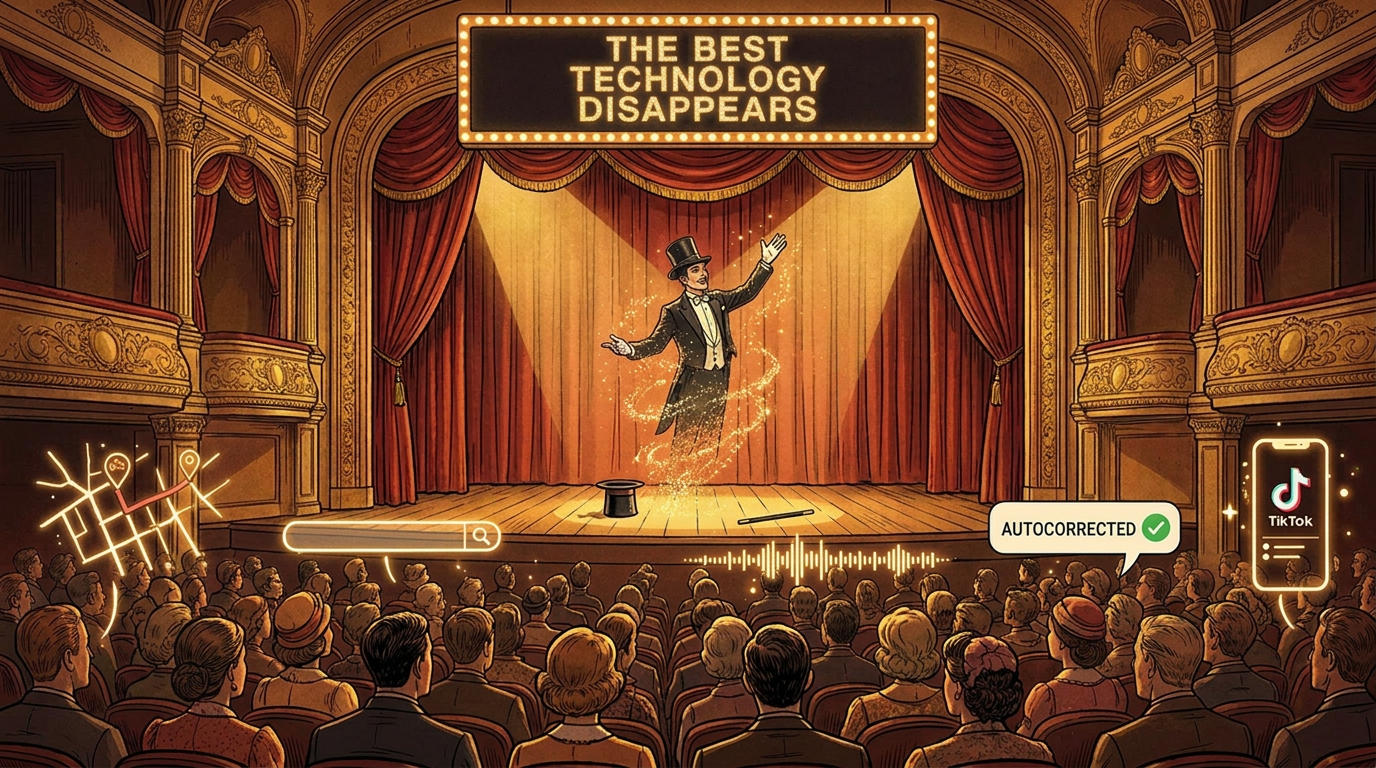
The best technology you'll ever use is the technology you'll never think about. TikTok, GPS, Google, autocorrect. Every one of them won by becoming invisible.
You spent 47 minutes on TikTok last night. You didn't decide to do that. You picked up your phone to check one notification, swiped once, and 47 minutes evaporated. You missed a text from your friend. Your dinner got cold. You looked up and the room was darker than when you sat down because the sun had moved and you hadn't noticed. At no point did you think "I'm using a recommendation algorithm." You didn't consider the transformer architecture ranking content by predicted watch time, you didn't appreciate the reinforcement learning loop adjusting in real time to your scroll speed and pause duration, you didn't marvel at the multi-armed bandit system serving you the exact ratio of familiar and novel content that keeps your thumb moving. You just felt the pull. One more video. One more. One more.
That's not an app, that's a disappearing act.
And it's the highest compliment a piece of technology can receive: you forgot it was there.
The Disappearing Act
Think about the last time you used GPS. You opened your phone, typed an address, and a blue line appeared. You followed the line. You turned when it said turn. You arrived. At no point during that drive did you think about the 31 satellites orbiting 12,550 miles above you, triangulating your position to within three feet using synchronized atomic clocks and relativistic time corrections. You didn't think about satellites at all. You thought about the turn.
That's the trick. The technology did something genuinely extraordinary, coordinating with objects in space traveling at 8,700 miles per hour, and your experience of it was: turn left in 200 feet.
Google did the same thing with search. Larry Page and Sergey Brin built PageRank, an algorithm that treats the entire internet as a citation graph, weighting pages by the authority of other pages linking to them, recursively, across billions of nodes. It was a breakthrough in computer science. And nobody on earth opens Google and thinks about PageRank. You think about the answer. You type a question, you get a result, you move on with your day. The technology is invisible.
Autocorrect is doing natural language processing on every single keystroke you type. Machine learning models are predicting your next word, evaluating probability distributions across your entire vocabulary, correcting errors you didn't even notice you made. You experience none of that. You experience: my text message looks right.
Every technology that changed the world eventually followed the same trajectory. It started as something you noticed, something you had to learn, something with a manual. And then it got better. And better. And at some point it crossed a line where you stopped seeing it entirely, where it dissolved into the experience so completely that removing it would feel like losing a limb but using it feels like nothing at all.
That's the line. And almost nothing crosses it.
Why Most Technology Is Still Visible
Here's what's strange about the disappearing act: most technology doesn't even try.
Most products want you to notice them. They want you to see the brand, appreciate the interface, admire the design system. Every notification is the product saying "hey, remember me?" Every loading screen is the technology reminding you it exists. Every update prompt, every onboarding flow, every tooltip, every "what's new" modal. All of it is the product waving its hand, begging for your attention when the best possible outcome would be for you to forget it's running.
Think about the apps on your phone that have truly disappeared. Your keyboard. Your lock screen. Your alarm clock. These are the apps you'd panic without, the ones that would wreck your morning if they vanished, and they're also the ones you literally never think about. You don't have opinions about your keyboard app. You don't follow its release notes. It just works, and that's the whole point.
Now think about the apps that are constantly reminding you they exist. The ones sending push notifications about features you don't use, the ones asking you to rate them after every interaction, the ones with splash screens and loading animations and progress bars. Every single one of those moments is a failure. Not a marketing opportunity, a failure. Because in that moment the user is aware they're using a tool instead of just doing the thing they sat down to do.
There's a reason TikTok doesn't show you the algorithm. Not because it's a secret (though it is), but because showing it would break the spell. The second you start thinking about why you're seeing a particular video, the pull weakens. The experience depends on the technology being invisible. The magic requires the magician to disappear.
And this is actually the hard part that most people building technology don't understand. Being invisible is not a feature you add at the end. It's not a coat of paint you apply after the engineering is done. It's the entire design philosophy from the very first line of code. You have to architect for disappearance, which means you have to solve the problem so completely that there's nothing left for the user to think about.
What Disappearing Actually Requires
This is, honestly, the hardest design problem in technology. And I think most people underestimate it because it sounds simple. "Just make it work so well people don't notice it." Sure. Easy. Except that's the equivalent of telling a musician to play so well the audience forgets they're listening to an instrument.
Disappearing requires solving every edge case. Not most of them, all of them. Because one edge case is one moment where the user becomes aware, one moment where the spell breaks, one moment where the technology becomes visible again. One wrong autocorrect suggestion and suddenly you're thinking about autocorrect. One bad GPS reroute and suddenly you're thinking about satellites. One buffering spinner on TikTok and suddenly you're aware you're staring at a screen.
The technology has to be right every time, or close enough to every time that the misses feel like flukes rather than patterns. That's an absurdly high bar. It's why so few products actually cross the invisibility line and why the ones that do tend to be worth hundreds of billions of dollars.
Google didn't disappear by having a nice UI. It disappeared because the first result was usually right. That's it. If the first result is right, you never think about search. You just get your answer and leave. The entire $1.7 trillion valuation traces back, at its core, to the experience of not thinking about Google while using Google.
TikTok didn't disappear by having a clean interface. It disappeared because the content selection is so precisely calibrated to your attention patterns that there's no gap between "I want to be entertained" and "I am being entertained." No browsing, no choosing, no deciding. Just the experience. And it took thousands of engineers and billions of data points to build a system so good it feels like nothing is happening.
The irony is thick. The most sophisticated technology in the world, the stuff that represents genuine breakthroughs in computer science and engineering, the stuff that would have seemed like magic twenty years ago... the measure of its success is that nobody notices it. Billions of dollars of R&D, and the best possible outcome is that the user shrugs and goes about their day. That's the goal. Not appreciation, not admiration. Indifference. Comfortable, habitual, unconscious indifference.
And honestly, I find that beautiful. There's something deeply elegant about solving a problem so thoroughly that the problem itself seems to stop existing. Not because you hid it but because you answered it, completely, and there's nothing left to see.
The Invisible Stack
There's a pattern here if you zoom out far enough. Every category of technology that truly disappeared followed the same path.
First it was visible. You noticed it, you had to learn it, you had to think about it every time you used it. Early GPS was like this. You'd stare at the screen, squint at the map, second-guess the route. Early search engines were like this too. You'd type a query, get ten pages of garbage, refine, try again, click through three links before finding what you wanted.
Then it became useful. The quality improved enough that you started relying on it, but you were still aware of it. You trusted GPS more but you still glanced at the route before driving. You trusted Google more but you still scanned multiple results.
Then it became habitual. You stopped questioning it. You just followed the blue line. You just clicked the first result. The technology became part of your routine, automatic, something you did without deliberation.
And then, finally, it became invisible. You stopped experiencing the technology at all. You experienced the outcome. Not GPS but the turn. Not Google but the answer. Not TikTok but the feeling. The technology dissolved into pure experience and all that remained was the thing you actually wanted.
You can actually watch this happen in real time with electric cars. Five years ago, people talked about their EVs constantly. Range anxiety, charging networks, regenerative braking, battery degradation. The technology was visible because it hadn't finished solving the problem. Now? People who've driven EVs for a few years just... drive. They plug in at home like charging a phone. They don't think about combustion versus electric, they think about getting to work. The technology is mid-disappearance, crossing from habitual into invisible, and you can feel the transition happening if you pay attention.
That last step is where 99% of technology stalls. Useful and habitual are achievable with good engineering. Invisible requires something else entirely. It requires the kind of obsessive, borderline unreasonable commitment to removing friction that most teams either can't sustain or don't even realize is the goal.
Nobody has done it for personal AI yet.
What This Means for What I'm Building
This is the lens I think about every day. Every design decision I make gets filtered through one question: does this make the technology more visible or less visible?
If the user has to consciously interact with the system, the design isn't done. If they have to remember to save something, the design isn't done. If they have to open an app, click a button, type a query to store context that should have been captured automatically, the design isn't done. Every manual step is the technology waving its hand. Every prompt is a loading screen. Every explicit interaction is the system reminding you it exists.
That's why I'm obsessed with automatic ingestion. Background processing. Hardware integration. Things that capture context without asking, that encode what matters without being told, that surface the right information at the right moment without anyone requesting it. The goal isn't a better tool, it's no tool at all. Just the experience of being understood.
I built TrueMemory with this philosophy at the center. Not "here's a memory system you can use" but "here's a memory system you'll forget is running." The architecture is modeled on how biological memory works, an encoding gate that filters experience before storage, novelty and salience scoring that happens automatically, natural decay that keeps the system from drowning in its own history. All of it designed to be invisible. The research paper details the full architecture, but the thesis fits in one sentence: if you're aware you're using a memory system, the memory system has failed.
Every feature I evaluate gets the disappearance test. Does this bring us closer to invisible or further away? Will the user notice this, and if so, why? What would it take to solve this so completely that there's nothing left to notice?
Most AI products right now are firmly in the "visible" stage. Chatbots, prompts, interfaces, copy-paste workflows, context windows you have to manually manage, conversation histories you have to scroll through, system prompts you have to write and rewrite. All of it screaming "you are using AI" at every step. Some are moving toward useful. A few are approaching habitual. None have disappeared. Not yet.
But the trajectory is clear. The same path that GPS followed, that search followed, that autocorrect followed. Visible, useful, habitual, invisible. Personal AI will follow it too. The only question is who builds the version good enough to vanish.
The Last Step
The best technology you'll ever use is the technology you'll never think about. Every great product followed the same path: visible, then useful, then habitual, then invisible. That progression isn't optional, it's the definition of a technology that actually worked. The ones that stay visible are the ones that never finished the job.
That last step is the hardest. It requires solving the problem so completely there's nothing left to see, nothing left to click, nothing left to think about. It requires the confidence to build something extraordinary and the restraint to let it disappear.
It's also the only one that matters.