The Real Moat Isn't Software
Everyone in AI is fighting over software wrappers. The real moat is hardware: getting AI out of the chatbox and into the physical world. I built a 5-node camera network for $500 to start solving it.
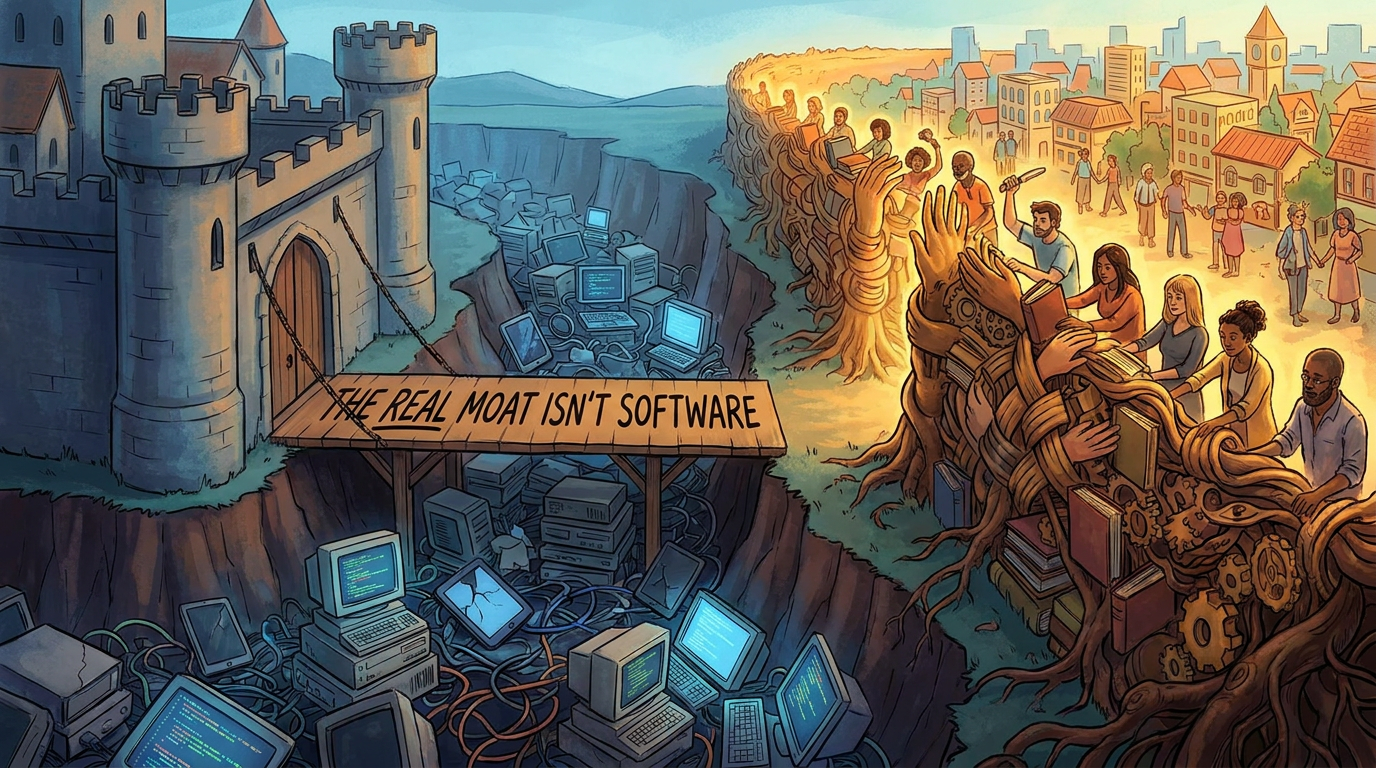
Every AI memory company is competing to build the best context manager for a chat interface. Better RAG pipelines, better vector search, better prompt engineering, better summarization. Investors are pouring money into who can build the smartest software wrapper around Claude or GPT. And every single one of them is fighting over maybe 1% of the problem.
The other 99% is happening in the physical world, where your AI has never been.
The Chatbox Trap
Think about how your AI knows you right now. It knows what you type. That's it. Every preference, every decision, every piece of context your AI has about you came through a text box. You had to manually tell it, explicitly, in words, during a conversation you chose to have, about a topic you remembered to bring up.
That is an insane way to build understanding of a person.
It's like trying to understand someone by only reading their emails. You'd get a slice of their professional communication, maybe some personal stuff if they're the type to write long emails, but you'd miss everything that actually makes them a person. How they move through their apartment in the morning. Whether they eat breakfast or skip it. The fact that they pace when they're stressed. That they always check their phone right before bed, that they talk to their dog in a specific voice, that they sit in the same chair every single day but never at the desk they bought specifically to sit at.
None of that makes it into a chat interface. Not because it's not valuable, but because nobody thinks to type "hey Claude, I pace when I'm stressed" into a text box. That's not how self-knowledge works. Most of the patterns that define you are invisible to you because they're automatic. You don't notice them, so you never report them, so your AI never learns them.
And the stuff people do explicitly share is filtered through self-perception, which is notoriously unreliable. People tell their AI they work out four times a week when they actually go twice. They say they eat healthy when they order DoorDash at midnight. They describe themselves as morning people while consistently opening their laptops at noon. The gap between who you think you are and who you actually are is massive, and chat-based AI has no way to close it because it only ever gets the self-reported version.
The result is that every AI system today is working with a comically incomplete picture of the person it's supposed to be helping. The models are smart enough. The input layer is broken.
Why Hardware Is the Actual Moat
Here's what nobody in the AI memory space wants to hear: software can be replicated in a weekend. A better RAG pipeline, a smarter reranking algorithm, a novel encoding gate, those are all real innovations but they're also all just code. Somebody reads your paper, understands the approach, builds their own version. I know because I've watched it happen.
Hardware infrastructure can't be replicated like that. The physical deployment, the sensor calibration, the months of debugging driver conflicts and thermal issues and network topology, that's a moat that no amount of clever prompting can cross.
I built a five-node sensor network in my apartment. I call it Paradox. Five Raspberry Pi Zero 2W boards, each running an ArduCam IMX708 12MP wide-angle camera with 120-degree field of view, plus WM8960 audio HATs for microphone capture. The whole thing cost about $500 in hardware. Custom Python daemon on each node handling motion-triggered and audio-triggered recording, streaming at 1280x720 at 15fps, with a low-resolution 320x240 stream for motion detection. All of it shipping to a NAS for storage, with inference running on an RTX 5090.
That sounds clean when I describe it in a paragraph. The reality was months of garbage.
The camera selection alone almost killed the project. I started with OwlSight 64MP sensors running the ov64a40 driver. They looked incredible on paper, 64 megapixels, beautiful image quality. They also ran so hot that the Pi Zero 2W would thermal throttle within twenty minutes and the driver was a nightmare, requiring a custom dtoverlay configuration with a specific link frequency parameter that I spent entire nights debugging. I'd be up at 2am staring at dmesg output, trying to figure out why the camera would initialize on one node but not another with the identical SD card image. The answer was always something dumb... a loose ribbon cable, a kernel version mismatch, a power supply that couldn't sustain the current draw.
I eventually ripped all of them out and switched to the IMX708. Less impressive specs, dramatically more stable. That single decision, picking the boring reliable camera over the flashy one, is the kind of lesson you only learn by actually building hardware. Software engineers optimize for capability. Hardware engineers optimize for "does it actually work at 3am when nobody's watching."
But here's the thing that made it worth all of that pain: one hour of physical observation gives you more behavioral data about a person than a year of chat transcripts. I'm not exaggerating. Within the first week of having Paradox running, the system had captured patterns I never would have typed into a chat interface. Movement patterns through the apartment, sleep schedule consistency, how long I actually sit at my desk versus how long I think I sit at my desk. Honestly, the gap between self-reported behavior and observed behavior is enormous, and that gap is exactly where AI understanding falls apart.
When your AI can tell you that you've been averaging 45 minutes less sleep this week than last week, not because you logged it in an app but because it watched the lights go off and the lights come on, that's a different kind of intelligence, not smarter reasoning but reasoning with actual information instead of whatever scraps you remembered to type into a prompt.
The observation layer is the missing piece. Everyone is building smarter reasoning on top of the same garbage input, and nobody is fixing the input.
The Honest Limitations
Now here's where I have to be straight with you because I'm not going to pretend this is solved. It's not. The observation layer has real constraints that no amount of engineering enthusiasm can hand-wave away.
You can't put a camera in your car. You can't put one in your office if you work at a company that would rightfully fire you for bringing surveillance equipment to work. You can't wear Meta glasses to dinner without looking like a person who wears Meta glasses to dinner, which is its own social penalty. The spaces where some of the most meaningful behavioral data exists are exactly the spaces where cameras are socially unacceptable, legally complicated, or both.
Privacy is the obvious one but it's not even the hardest constraint. Battery life is brutal. The Pi Zero 2W draws about 1.5 watts idle but spikes to nearly 4 watts under camera load, which means you can't run these things on battery in any meaningful way, they need to be plugged in permanently. Data bandwidth is another wall. Five cameras at 15fps generates a genuinely stupid amount of data, and even with motion-triggered recording the NAS fills up faster than you'd expect. I spent a week building a cleanup pipeline just to keep the storage from overflowing.
And then there's the social cost.
My girlfriend didn't talk to me for two days after I installed the cameras. Two days. And honestly, I get it. "I'm building an observation layer for my AI memory system" is not a sentence that makes someone feel comfortable in their own home, no matter how you frame it. I tried explaining the technical architecture, the data pipeline, how the footage gets processed and encoded. She did not care about the data pipeline. She cared about the fact that there were cameras in the bedroom and the kitchen and the living room and they were always on.
We worked it out. There are zones now, rooms where the cameras don't run, times when the system goes dark. But that experience taught me something important: the technical capability to observe everything is not the same as the practical ability to observe everything. Social acceptability is a constraint as hard as any engineering limitation, maybe harder, because you can't debug your way out of it.
Meta is spending billions trying to make their glasses look normal enough that people will wear them in public without feeling like they're cosplaying a Black Mirror episode. That's not a solved problem. Humane's AI Pin flopped partly because nobody wants a camera pointed at them during a conversation. The observation layer doesn't just need to work technically. It needs to work socially, and right now it doesn't.
Where This Goes
So if you zoom out, there's a three-layer stack that nobody is thinking about correctly.
Layer 1 is Observation. Getting data from the physical world into a format that AI can process. Cameras, microphones, sensors, wearables. This is the layer I'm building with Paradox.
Layer 2 is Memory. Taking that raw observational data plus conversational data and encoding it intelligently, deciding what matters, letting stale information decay, surfacing the right context at the right time. This is what I built TrueMemory to do, and the architecture is described in my arXiv paper.
Layer 3 is Reasoning. The actual LLM inference. Claude, GPT, whatever comes next. The part that thinks.
Right now, billions of dollars are flowing into Layer 3. Anthropic, OpenAI, Google, Meta, all building better reasoning engines. And the reasoning is getting incredible. But Layer 3 is reasoning on top of almost nothing because Layers 1 and 2 barely exist.
It's like building the world's most powerful engine and putting it in a car with no windows. The engine is extraordinary. It just can't see the road.
The companies that figure out unobtrusive observation, memory that's actually intelligent rather than just storage with a search bar, those companies will own the next decade of AI. Not because they build the smartest model but because they give the smart models something real to think about.
Think about what happens when these layers actually connect. Your AI notices you haven't left your desk in six hours, cross-references that with your calendar showing three back-to-back meetings, remembers from last month that this pattern precedes you getting sick, and proactively suggests you take a break. Not because you asked. Not because you typed anything. Because it was in the room with you, it remembered what happened last time, and it connected the dots. That's not a chatbot. That's something closer to what AI assistance was always supposed to be.
Nobody is going to win by building a better chat interface. The chat interface is a temporary artifact of the fact that we haven't figured out how to get AI into the room with you. The second someone cracks that, the entire "type your question and wait for a response" interaction model becomes as archaic as command-line computing looked after the GUI showed up.
The Room, Not the Screen
I don't have this figured out. I have five cameras in an apartment generating data that I'm still learning how to process, a girlfriend who tolerates it with conditions, and a NAS that fills up faster than I'd like. The observation layer is messy, limited, socially complicated, and genuinely hard in ways that writing better software isn't.
But I also know that the moat isn't who builds the best context manager for a chat window. It's not who has the cleverest RAG pipeline or the most efficient vector index. Those things matter and I've built them, but they're not the thing.
The moat is who gets AI into the room with you. Who figures out how to observe the physical world in a way that's accurate enough to be useful, unobtrusive enough to be acceptable, and intelligent enough to know what to keep and what to throw away. That's a hardware problem, a social problem, and a memory problem all tangled together, and it's going to be a lot harder than fine-tuning a prompt template.
That's why I'm up at 2am debugging dtoverlay configurations instead of writing another wrapper around the OpenAI API. The hard part isn't the software. It never was.